
The Player Boards
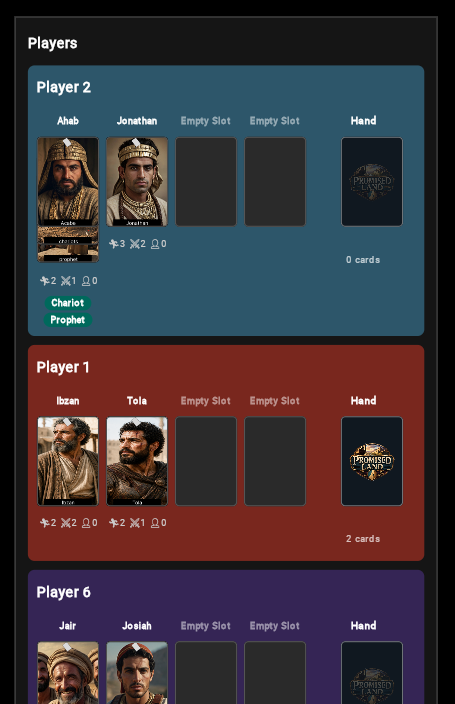
To the left of the map sits the Players panel: one rectangle per player, painted in a muted version of that player’s colour. It is where you read everyone’s situation at a glance.
Everything shown on the boards is public information — each player’s generals, their stats, the items they carry and the titles they hold. The one exception is the hand, which appears only as a pile of face-down cards: you can see how many cards an opponent holds, never which.
Anatomy of a board
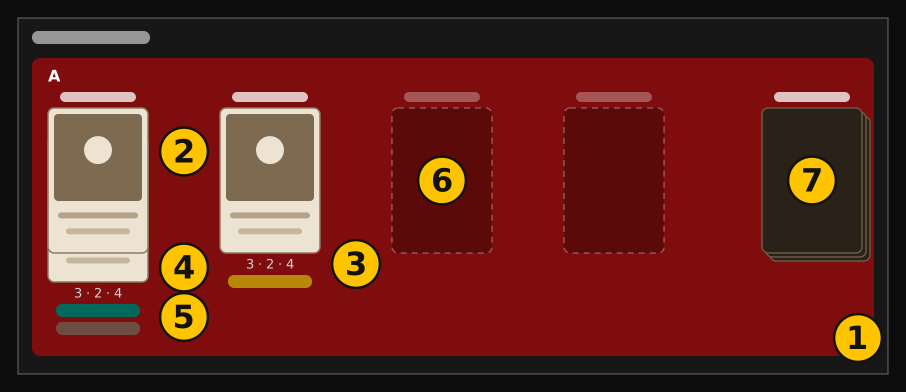
- The player’s strip — the name at the top and the background in that player’s colour. Every player gets a strip; eliminated players vanish from the panel.
- General slot — the card of one of your generals that is on the map. Each player has 4 slots. A light bar above the card carries the general’s name. Long-pressing the card opens its details.
- Stats — the three-number line under the card: movements · strength · commanded troops. The first two come from the card; the third changes as the general takes on or hands over troops.
- Attached item — when a general carries an item, the item’s card appears underneath theirs with about a fifth of it showing. Several items stack, each at its own depth.
- Pills — coloured bars below the stats, one per condition of that general:
- teal — the name of an item they carry (one pill per item);
- brown — the Judge title they hold;
- dark blue — ⛓ Captive, when taken prisoner by another player;
- purple — 🗡 Assassin, when they carry that mark;
- gold — 👑 King.
- Empty slot — a slot with no general: either you have not placed one there yet, or the general who was there has died.
- Hand pile — the cards in your hand, face down. Only your own pile is clickable, and it opens the Hand window.
One usage detail: while you are attaching an item, your generals in the panel start pulsing green and become clickable — that is how you pick which of them receives the item.
What the order of the boards means
The boards are not in a fixed order. Each round they are restacked in that round’s turn order: the board on top belongs to the player who acts first, the second to whoever is next, and so on down to the last.
The starting order is drawn at random when the game is created. The players are shuffled, so they do not follow the sequence in which they were entered on the New Game screen — which is why, as early as round 1, the top of the panel might be “Player 6” with “Player 1” sitting in the middle of the stack.
And that order rotates by one seat every round. Whoever opened round 1 becomes the last in round 2, and the second player takes the lead:
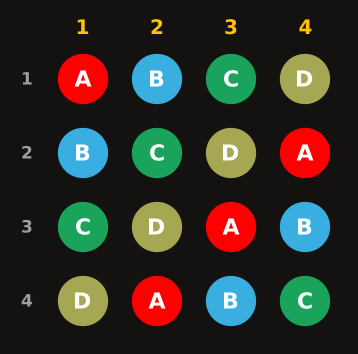
In the figure, the gold columns are the rounds and the grey rows are the positions in the panel, top to bottom. With four players (A, B, C, D):
| Round | Order of the boards |
|---|---|
| 1 | A · B · C · D |
| 2 | B · C · D · A |
| 3 | C · D · A · B |
| 4 | D · A · B · C |
| 5 | A · B · C · D (starts over) |
In other words, every player leads once every N rounds, N being the number of players. Nobody is stuck in last place.
Why this matters in play:
- Reading the panel top to bottom is reading who acts before you that round. If your board is third, two players move and attack before you can react.
- Opening the round has value: you claim settlements, occupy hexes and declare battles before the others get into position.
- Closing the round has value too: you take your turn already knowing what everyone else did.
One important detail: eliminated players are removed before the rotation is applied. When someone is knocked out, the cycle turns among those who remain — the panel shrinks and the sequence changes.
Generals and Items
Two of the game’s four card categories show up on the player boards: generals and items. (The other two do not: event cards go straight to the Events Area, and single-use cards stay in your hand until played.)
The essential difference is simple: a general is a piece; an item is not.
A general becomes a piece on the map. They have a position of their own, occupy a hex, move, command troops and fight. That is why a general takes up one of the four slots on your board — the slot stands for one of your generals in the field.
An item never goes onto the map by itself. It is attached to a general already placed and travels with them wherever they go. On the board an item gets no slot of its own: it appears tucked under its bearer’s card.
| General | Item | |
|---|---|---|
| Where it is placed | on a hex of the map | onto a general already placed |
| Takes a board slot | yes, 1 of 4 | no — it sits with its bearer |
| Moves on its own | yes, according to its movements | no, it travels with whoever carries it |
| Stats of its own | movements and strength | none; it grants effects to its bearer |
| Duplicates | you may have several different generals | a general cannot carry two items of the same kind |
| When the bearer falls | goes back to the discard pile | all of their items are discarded with them |
A few practical rules that apply to both:
- You may have at most 4 generals on the map at a time — that is the number of slots on your board.
- In the first round, each player is dealt two generals and must place both before ending the turn.
- Your hand holds at most 4 cards; go over that and the turn will not end until you discard.
- Items are attached during the **Draw Cards** phase: tap Place on the item card, then tap the general who will receive it.
- When a general dies or is captured, every item they carried returns to the discard pile and can be drawn again.
What each general and each item actually does — stats, effects and how to use them — is left to the chapter The Game’s Cards.