
The Automatic Phases: Income and Check Victory
Two of the round’s seven phases ask nothing of you: Income (phase 3) and Check Victory (phase 7). The game resolves them on its own and delivers the result as a notification in the bell, instead of interrupting the turn with a window.
Passing by unattended does not make them minor. One decides how much money you carry into Acquisitions; the other decides who won.
Phase 3 — Income
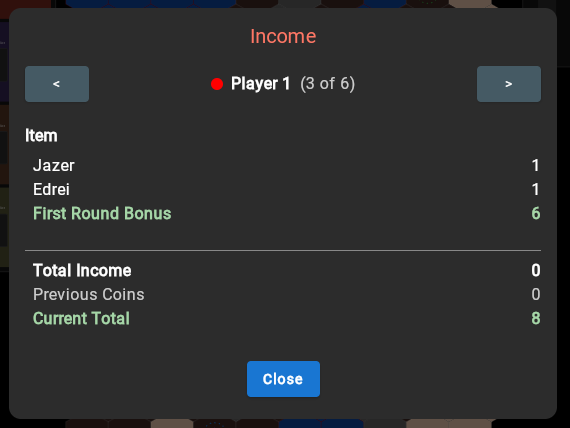
Income is credited automatically just before Acquisitions. You enter the buying phase with your balance already updated.
What each settlement pays
| Source | Value |
|---|---|
| Village | 1 coin |
| City (a judge’s capital) | 2 coins |
| Each development on it | +2 coins |
| Abundance on its terrain | +1 coin |
| Hunger on its terrain | −1 coin |
A settlement counts as yours when you own the garrison or have a general standing on it.
In round 1 everyone also receives 6 coins as a stake, so there is something to spend in the first Acquisitions phase.
What zeroes the income
Two cases wipe out what a settlement would have paid:
- A settlement under siege — it produces nothing for anyone while the siege lasts.
- A settlement in a taxed region — it pays its owner nothing that round.
The Tax deserves attention because it is not merely a deprivation: whoever played the card collects twice the value of every settlement in the region — including those belonging to other players and those in Canaanite hands. The only exception is besieged settlements, which pay neither the owner nor the taxer.
An example
You control a city with 2 developments and two villages, one of them on terrain struck by Hunger:
- city: 2 + (2 × 2) = 6
- ordinary village: 1
- village with Hunger: 1 − 1 = 0
Total: 7 coins — a wall minus three coins, or three troops and a development.
Each round’s financial report is kept in the notification, with the previous balance and how much came in.
Phase 7 — Check Victory
Once the Combat phase closes, the game counts the points. This phase only stops when somebody wins — otherwise it passes and the next round begins.
Before counting, the game tidies up: captive custody is reconciled. A captive standing on a hex their captor no longer controls passes to whoever controls that hex — and is freed outright if that controller is their original owner.
Victory points
It takes 3 points to win, and there are exactly three sources:
| Source | Points | Condition |
|---|---|---|
| Judge title | 1 per title | while it is filled by a living general |
| King title | 1 | while a king reigns |
| Tabernacle | 1 | while the general carrying the Ark stands on its hex |
A vacant title — one whose judge died and has not been replaced — is worth nothing. A title whose judge is captive, on the other hand, still scores: they lose the right to vote in the King election, but the point remains.
Since there is no limit to how many Judge titles one player may hold, the most common road to 3 points is dominating three whole regions. The details of each title are in the chapter Judges and Kings.
Ties
If more than one player reaches the top score in the same round, the tie is broken by number of settlements controlled. And if it is still tied after that, the victory is shared — the game declares more than one winner.
The four ways a game ends
| Ending | What happens |
|---|---|
| Someone reaches 3 points | They win (or they all do, on an unbroken tie). |
| Last one standing | Every rival has been eliminated: the survivor wins. |
| Region collapse | Fewer than 3 regions can still support a judge — each needs 4 standing settlements. The land is judged and everyone loses, with no winner. |
| General elimination | The last active players are eliminated in the same round: game over with no winner. |
Region collapse is the ending that catches people out: it does not depend on anyone attacking you. It is enough for the players — and the Wrath of God invaders — to raze too many settlements. Looting pays, but every settlement destroyed brings the table closer to that shared ending.
Elimination
A player is eliminated when they are left with no settlement and no free general. Captive generals do not count as presence: if all your generals are in enemy hands and you own no settlements, you are out.
Elimination is decided here but announced in the following Announcements phase. From then on that player’s turns are skipped and their board disappears from the Players panel.
The round report
Every round that closes generates a Round Report notification for each player, gathering the scores, the battles fought, and the round’s actions (executions, taxations and revolts).