
The Movement Phase
Movement is the fifth of the seven phases of each round — the phase where the board changes shape. Here generals march, take command of troops, and lay siege to enemies. It is also the phase that decides the next one: wherever generals come to rest, Combat will follow.
One move per general, per round
Each general may move only once per round. Once they have marched they stay put until the next one — there is no splitting a move into two steps and no taking it back.
This applies to each of your generals independently: you may move one, two, or all of them, in whatever order you like, during your turn.
How to move
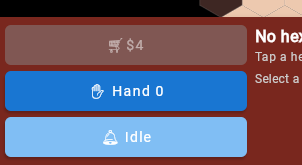
To see which generals you can still move this round, tap the Idle button. It will highlight the next general that still has a move.
Select the general and the hexes within their reach light up on the map:
- green outline — a free destination;
- red outline — an enemy or neutral settlement, that is, a destination that means attack.
Tap the chosen hex and the general walks the route hex by hex. You do not have to plot the path: the game always works out the cheapest route to the destination.

Terrain cost
Every general has a movements value printed on their card — 2, 3, or 4 — and spends those points on entering each hex:
| Terrain | Cost |
|---|---|
| Plain | 1 point |
| Mountains | 2 points |
| Desert | 2 points |
| Water | impassable |
A 3-point general crosses three plains, or one plain and one mountain — but not two mountains. The details are in the chapter The Board.
What blocks a move
Beyond the cost, several rules limit the destination:
- Enemy or neutral settlements can be a destination, but not a thoroughfare. You may march onto one to attack it, but not through it to reach what lies beyond.
- A hex under siege is sealed: nobody enters or leaves it except the generals of whoever is conducting the siege. A besieged general cannot move.
- At most 2 of your generals per settlement — a third will not fit.
- Only one player may attack a hex at a time. If another player is already attacking that hex, your general cannot move onto it.
- During a Sandstorm, the desert and every neighbouring hex are sealed. A general standing on one of them cannot move at all that round.
- A general carrying the **Prophet** cannot initiate battle: they may not enter a hostile hex or lay siege.
- A captive general, moved by their captor, has only 2 points of movement, may never enter a hex holding an enemy presence, and cannot be marched into a settlement that already holds 2 captives.
Taking command of troops
A general standing on one of your settlements can take the garrison’s troops under command — that is how they gain the strength to conquer anything. The hex panel offers + and − buttons to transfer them one at a time, up to the limit of 6 troops per general.
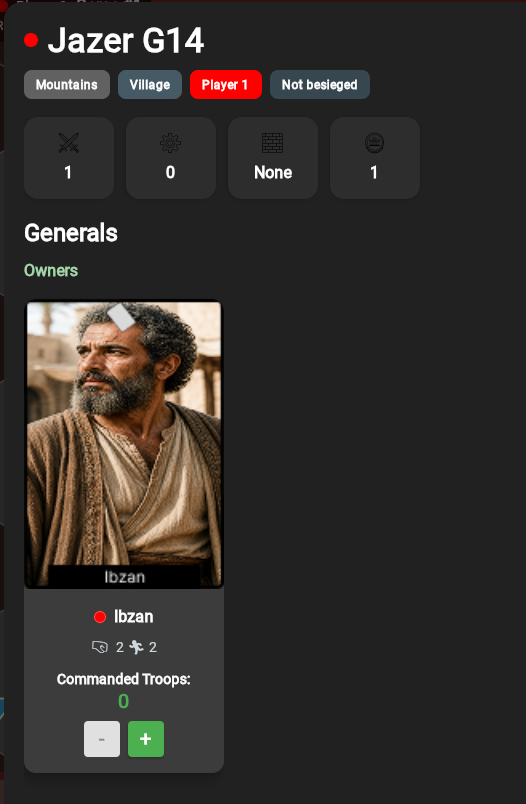
There is an important price: taking command of a troop consumes that general’s move for the round. They gather the army now and march the next round. Handing a troop back to the garrison with −, by contrast, costs no movement.
This is why so many campaigns take two rounds: one to gather the troops, another to attack.
Laying siege
When you have a free general on a hex controlled by another player, the hex panel offers the siege button. A siege is not only for settlements: you can surround an enemy general in the open field too.
What a siege does:
- it seals the hex — the trapped enemy cannot leave, and no reinforcements come in; only the besieger’s generals move freely;
- a besieged settlement produces no income and accepts no purchases in the Acquisitions phase;
- it melts the defence: the wall bonus falls from +4 to +2 and then to 0, and a judge city’s from +6 to +4, +2 and 0, counting from the round the siege began.
The siege lifts itself when the besieger’s last general leaves the hex — and there is also a button to end it manually. A general carrying only the Prophet cannot begin a siege.
Besieging before storming usually pays: each round of siege brings the wall down a little further, and a settlement that was untakeable in the first round becomes easy prey by the third.
The Secret Passage
The Secret Passage is the only card that can be played in this phase alone. Arm it before moving and, on the next move, that general may:
- leave a siege that holds them;
- enter or leave the desert during a sandstorm;
- ignore the wall bonus of the settlement they are storming, for that battle.
The card is consumed when the move happens. With it armed, the reachable-hex highlight already shows where the general can actually go.
Cards playable in this phase
| Card | In this phase? | Where else |
|---|---|---|
| Secret Passage | ✅ | only in this phase |
| Blessing | ✅ | [[60. Projects/Promised Land - manual/en/draw-cards |
| Revolt | ✅ (against a region taxed this round) | Draw Cards |
| Assassin | ✅ | any phase except Combat |
| Justice | ✅ (if some general carries the Assassin title) | any phase except Combat |
| Tax | ❌ | Draw Cards only |
| Siege Weapons, Ambush, Mercenaries | ❌ | only during a battle |
What comes next
Once everyone has finished moving, **Combat** begins. Wherever generals of different players have come to rest on the same hex, a battle may break out — which is why this phase’s last decision, where to stop, is usually the most important of the round.